

Belgium
The rank indicates the popularity of a country among users. By clicking on the 'Appreciate' button, you can contribute to elevating a country's rank. Each 'Appreciate' click adds to the country's rank, so feel free to express your appreciation by boosting countries with content that resonates with you.
...
Rank
...
Views
8
Please login to appreciate


No Buildings yet.








.png)


The Woodland Cabin is a self-built, low-budget, 35-square-meter retreat in the village of Nouvelles, Belgium, designed and constructed by London-based architecture studio De Rosee Sa. The project showcases the studio's craftsmanship and creative use of materials by replacing a dilapidated structure with a modern guesthouse and studio. The cabin is a modern interpretation of a classic black hut found in rural areas, designed to blend into its fairytale-like surroundings. Its simple, lightweight, and economical design was inspired by the local rural vernacular and built to a tight budget. The structure is set on the edge of a wood next to a tranquil lake, with its openings strategically placed to frame views of the natural scenery. The timber cladding and exposed beams were milled from trees in the surrounding woods that had been damaged in a storm several years prior. The wood was blackened and sealed using a mixture of wood stain and recycled tractor engine oil, a low-cost, durable treatment typical of local agricultural buildings. The walls and floors are lined with Oriented Strand Board (OSB), a robust and cost-effective engineered panel that complements the exposed timber beams. The simple, open-plan interior is centered around a wood-burning stove and can be used for working, sleeping, and socializing. Exposed scissor rafters create a vaulted ceiling, making the small interior feel more spacious. Black-framed windows draw attention to the surrounding landscape, and glazed doors open onto a wraparound timber deck. A small bathroom is discreetly tucked into one corner, and a small, covered porch serves as a mudroom. Project credits Architects: De Rosee Sa. Project Lead: Max de Rosee, founder of the studio. Structural Engineers: Form Structural Design. Photography: Will Scott Photography.


Architects:


"The Ecological Holiday Home is a 70-square-meter retreat in Brasschaat, Belgium, designed by POLYGOON Architectuur for clients Wim and Joosie. Completed in 2020, the project's primary goal was to create a comfortable, low-impact holiday house that would blend as much as possible into its forest surroundings. The design is defined by its strong ecological principles, using renewable, biodegradable, and recyclable materials in a circular construction process. The house is supported by 11 slender poles, allowing the structure to ""float"" about half a meter above the forest floor, minimizing its physical and visual footprint. This foundation system means the house can be moved in its entirety, with the option to add two extra poles for a terrace. The cabin's form is an organic pentagonal plan with three obtuse corners, giving it a soft, non-intrusive character in the woods. It features a single-pitch roof that reaches a height of 7 meters at the rear, creating a sense of spaciousness within the compact footprint. The wooden skeleton was prefabricated and assembled in just five days, with the clients themselves contributing to the exterior cladding and interior finishes. The exterior is clad with locally sourced, barked larch planks over fiberboard, and the interior uses oriented strand board (OSB) panels. Energy efficiency is a key feature, with the house so well-insulated that a single wood stove is sufficient for heating. An air-source heat pump was also installed to heat sanitary water efficiently. Recovered and recycled materials were used for the kitchen and bathroom furnishings. Credits Architects: POLYGOON Architectuur Lead Architects: Domien Boits, Bram Van Bouwel Contractor: Luc Van Overveld Photographer: Jessy van der Werff Manufacturers: RENSON, Adobe, Ariston, Eternit, JØTUL, Nemetschek, Steico Clients: Wim and Joosie"


Architects:

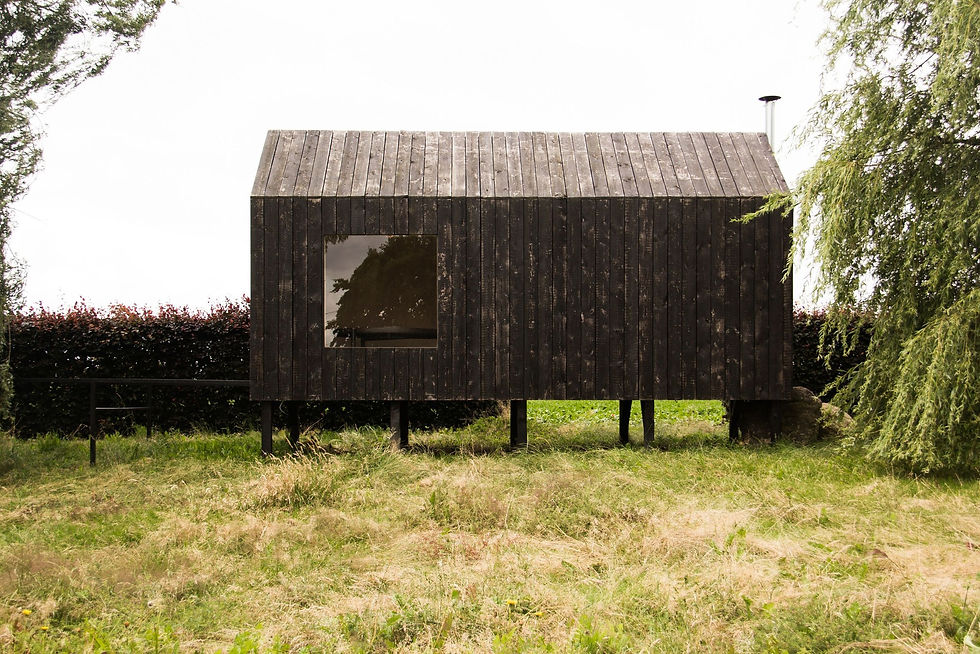
"The Hofer Pavilion is an experimental, 28-square-meter studio designed and self-built by Stal Collectief, a Belgian furniture design company. Completed in 2016, the pavilion is situated near the collective's existing workshop in Heppeneert, a hamlet in northeast Belgium, and was created as a retreat for brainstorming sessions and design discussions. Mimicking the traditional, archetypical shape of a rural gabled home, it blends into its surroundings. A key feature of the pavilion is its adaptability to different weather conditions and uses. The structure is elevated on ten pillars and features a unique rail system that allows three of its four walls and the roof to be moved. This design makes it possible to open the studio to the elements during warmer seasons, transforming the interior into an open-air living space, and enclose it during winter for a more intimate setting. The exterior is clad in charred timber using the traditional Japanese shou sugi ban technique, giving it a dark, rustic appearance that references the local vernacular. The fixed gable wall and floor, in contrast, are finished with sheet metal. The interior is minimally furnished with a long table, stools, lighting, and a wood-burning stove built into the fixed wall. Credits Architects: Stal Collectief (Len de Paepe, Bob Segers, Tim Vranken, and Jonas Blondeel) Photography: Bob Segers "


Architects:


The Alex Guesthouse is a sculptural and cinematic retreat designed by the Ghent-based firm Atelier Vens Vanbelle for a client in the film industry. Located in the idyllic Uitbergen region of East Flanders, Belgium, the project was created with a single directive: to build something that his guests would remember forever. The guesthouse was completed in 2020. The design is a sequence of unfolding experiences that take guests on a journey from the familiar to the surreal. Guests enter the main house, walk through a garden and bicycle shed, and descend a staircase into a long, disorienting, and dark underground corridor. The journey culminates in the guesthouse itself, which is reached via a spiral staircase that rises from the basement. From the exterior, the guesthouse appears as an abstract, Corten steel-clad tower, sometimes likened to a lighthouse or a submarine. The facade is designed to weather naturally and blend with the surrounding landscape of trees, a nearby castle, and the river Schelde. The spiral staircase continues past the guesthouse to a unique watchtower. A glass dome at the tip of the tower floods the staircase with light, and the highest level features an outdoor shower that offers a unique connection to the surrounding nature. The guesthouse was designed as a single, large piece of furniture and constructed layer by layer from laminated veneer lumber (LVL) in an off-site studio. It was then transported to the location in four sections and rebuilt on-site. Interior and layout The guesthouse and its subterranean extension offer a variety of intimate and atmospheric spaces. The "wooden cave": The guest area, located on the first floor, is a serene space crafted entirely from layered LVL wood, creating a "wooden cave" or "grotto" effect. The wood forms the floors, walls, ceilings, and even the custom furniture, including a bed base and bookcase. Framed views: Two large, circular windows puncture the wooden interior, framing specific views of the garden and the neighboring castle. Underground cinema and bar: The underground level contains a dark and moody cinema and a small bar, providing a private space for entertaining and screen previews. Terrace: A small, private terrace is located on the slope outside the entrance, offering guests a place to enjoy the evening sun. Project credits Architect: Atelier Vens Vanbelle Team: Dries Vens and Maarten Vanbelle Client: Private Photography: Tim Van de Velde Location: Uitbergen, East Flanders, Belgium


Architects:


