

Slovenia
The rank indicates the popularity of a country among users. By clicking on the 'Appreciate' button, you can contribute to elevating a country's rank. Each 'Appreciate' click adds to the country's rank, so feel free to express your appreciation by boosting countries with content that resonates with you.
...
Rank
...
Views
0
Please login to appreciate










Located in the historic centre of Ajdovščina, Slovenia, the project known as Najmanjšahiša is a remarkable transformation of a former woodshed into a compact contemporary dwelling. Designed by architect Sanja Premrn, the area of this innovative living unit is 25 m² (269 ft²). The design retains the essential character of the original structure while adapting it for modern living. The project preserves the existing masonry walls and building footprint, respecting the scale and identity of the surrounding historic urban fabric. This thoughtful approach ensures that the new dwelling harmonizes with its environment, maintaining the architectural integrity of the area. Key features of the intervention include the addition of a new timber gable roof, high-performance thermal insulation, and energy-efficient construction solutions. The façade is simply rendered and complemented by timber shutters, which contribute to the understated appearance of the building, allowing it to blend seamlessly with its surroundings. Inside, the layout is organized as a bright, open-plan studio. The living and sleeping areas are subtly defined through the use of built-in furniture, creating a functional and aesthetically pleasing space. A separate bathroom enhances the unit's practicality. New window openings provide ample daylight and facilitate direct access to the garden, reinforcing the connection between the interior and the outdoor environment. The Najmanjšahiša project exemplifies how a modest historic outbuilding can be sensitively adapted into a contemporary home, preserving its architectural heritage while meeting the needs of modern living. Project credits Architects: Sanja Premrn Photography: Miha Bratina Location: Ajdovščina, Slovenia


Architects:


Inspired by the traditional farmhouse and hayrack that once occupied the site, Her arhitektura's Hiša Š is a striking and sympathetic reinterpretation of rural vernacular architecture, situated in a small farming hamlet in Slovenia. The 262 m2 residence balances traditional form with contemporary expression, integrating itself harmoniously with its surroundings through a thoughtful use of material and structure. The design is intrinsically shaped by the sloping terrain of the site. A partially underground basement, constructed from exposed concrete, anchors the home, providing a grounded counterpoint to the warm wooden structure above. This lower level accommodates practical spaces such as a large garage and service areas, as well as a more rustic "country-style room". The main living spaces are located on the upper floor, where the ceiling soars dramatically to the roof ridge, revealing the exposed timber frame and creating a sense of spaciousness. A sleeping area is also on this floor, with a gallery above it designed as a flexible and playful space for the owners' grandchildren. A key architectural element that bridges the new design with the regional building traditions is the covered porch, or gank, on the eastern side of the building. This external corridor connects the rooms on the ground floor, functioning as both a practical pathway and a symbolic link to the communal outdoor spaces of historic rural dwellings. This gesture, along with the prominently visible timber frame and the use of natural materials, ensures the new build feels both modern and deeply connected to its alpine setting. The interior of Hiša Š contrasts the rustic wooden structure with a clean, contemporary aesthetic. Modern furniture and materials are balanced with carefully chosen color accents and wallpaper. A notable feature is the suspended, rotating fireplace, which serves as a central point of life during colder months. In warmer weather, the living area can be extended outdoors onto a terrace and towards the pool area, which is cleverly shielded from the road by a green barrier. Through this project, Her arhitektura successfully delivered a home that respectfully nods to its heritage while providing a distinctly modern and functional space for its inhabitants. Credits Architecture: Her arhitektura Main Contractor (Wood Construction): Alfa natura d.o.o. Photography: Ana Skobe


Architects:


"Nestled on a high mountain plateau at 2,080 meters above sea level in Slovenia's Kamnik Alps, the Bivouac Under Grintovec, also known as the Pavle Kemperle Shelter, is a three-story minimalist shelter designed by architect Miha Kajzelj. Built in 2009 to replace an older, deteriorating bivouac, the new structure serves as a free refuge for mountaineers navigating the rugged landscape of Veliki podi beneath Mount Grintovec. Its vertical form is intended to be a highly visible landmark, easily spotted by hikers against the rock in summer or snow in winter. The shelter's design was heavily influenced by the extreme alpine environment and the logistical challenges of building at such a remote site, accessible only by foot. The components of the bivouac were prefabricated for minimal weight and transported to the site by helicopter. It rests on a small concrete base anchored into the bedrock, minimizing its footprint on the landscape. The structure is a simple volume, measuring 2 by 3 meters with a height of 4.5 meters. The exterior is clad in black aluminum panels, which contribute to its striking appearance against the backdrop of the mountains. The interior, with a total floor area of 14 square meters, is arranged across three vertical levels connected by a ladder. Large, vertical windows are strategically placed at the corners to frame dramatic views of the surrounding peaks, giving the impression that the upper sleeping levels are ""floating"" above the mountain scenery. The bivouac is unheated but designed for energy efficiency. The aluminum outer panels provide insulation to retain the heat generated by the occupants' bodies, while the inner skin of perforated wooden panels allows moisture to escape, ensuring a dry and warm interior. The vertical layout means that heat naturally rises to the upper sleeping levels, which can comfortably accommodate up to eight people. The ground floor provides a living and dining area with benches and a small table. The successful realization of the bivouac earned Miha Kajzelj the Plečnik Medal in 2011. Project credits Architecture: Miha Kajzelj Photography: Matevž Paternoster Client: Gorska reševalna služba Kamnik (Kamnik Mountain Rescue Service) Original Structure: Built in 1973 by the Kamnik Mountain Rescue Service"


Architects:


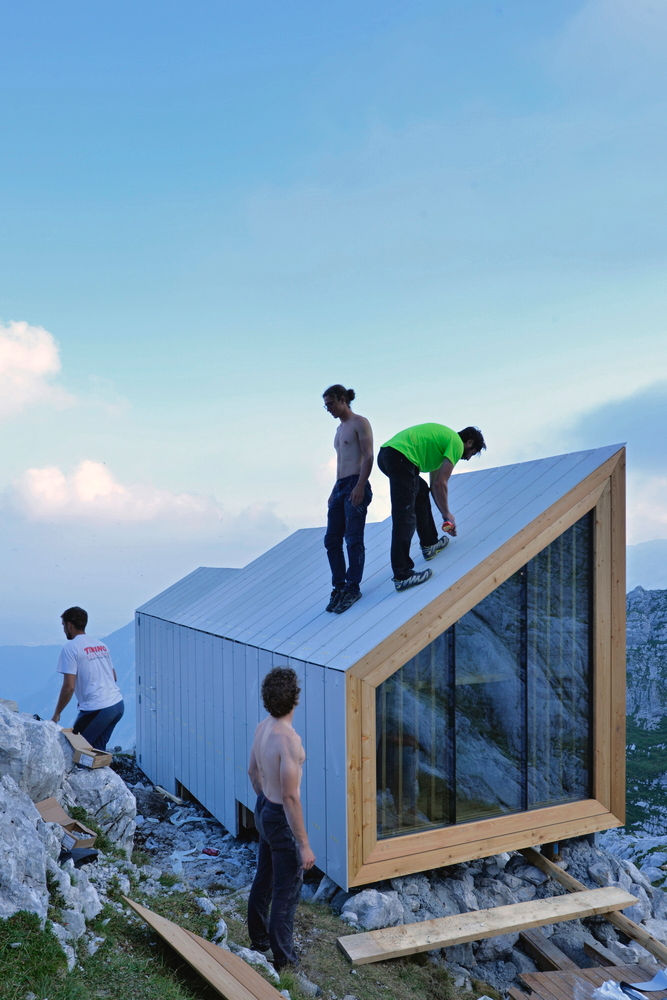
"Designed to replace a 50-year-old, dilapidated shelter, the Alpine Shelter Skuta is a free refuge for up to eight mountaineers on Mount Skuta in Slovenia's Kamnik Alps. The project is a collaboration between OFIS Architects, structural engineers AKT II, and students from Harvard University's Graduate School of Design (GSD), whose initial design studio work evolved into a fully realized architectural project. Conception and design. The project began in 2014 as a GSD design studio led by OFIS Architects' Rok Oman and Špela Videčnik, challenging students to design a modular shelter for extreme alpine conditions. The winning proposal, by students Frederick Kim, Katie MacDonald, and Erin Pellegrino, was inspired by traditional Slovenian vernacular architecture and features a robust, multi-faceted form. The final design, refined with input from mountaineers and engineers, consists of three prefabricated, 12-square-meter modules that are designed to resist heavy snowfall, strong winds, and extreme temperatures. Due to the difficult-to-access location at 2,080 meters above sea level, the modules were fabricated off-site and airlifted to the site by a Slovenian Army helicopter. More than 60 volunteers, along with the architects and engineers, completed the assembly in a single day, minimizing environmental disturbance. The modular construction and anchored base allowed for a quick, low-impact installation on the rugged, rocky terrain. The exterior is clad in a weather-resistant, silver-gray composite skin of glass fiber-reinforced concrete panels. This durable outer shell provides protection from the elements, while the interior is lined with natural larch timber panels to create a warm and inviting atmosphere. Floor-to-ceiling, triple-glazed windows on the end walls offer stunning panoramic views of the surrounding valley and mountains. The interior layout is functionally divided into three zones, with a ladder connecting the entrance and storage area, the central living and dining area, and the upper bunk sleeping quarters. Project credits Architecture: OFIS Architects (Rok Oman, Špela Videčnik) Structural Engineering: AKT II Design Studio Students: Frederick Kim, Katie MacDonald, Erin Pellegrino Volunteers and Mountaineers: PD Ljubljana Matica, Anže Čokl, Milan Sorc Client: PD Ljubljana Matica (local mountaineering club) External cladding manufacturer: Rieder Window glass supplier: Guardian Glass Photographers: Anže Čokl, Janez Martinčič"

Architects:


"The Simple House is a modern, prefabricated timber-frame home located in the scenic, rural landscape of Radovljica, Slovenia, and designed by the architectural firm Scapelab. Completed in 2006, the project offers a contemporary take on the traditional, archetypal Slovenian farmhouse. The house was designed to be cost-effective, energy-efficient, and low-maintenance, with a construction process that allowed for rapid on-site assembly The design is centered on a basic pitched-roof volume, but its cladding offers a unique, modern interpretation. The facade features a veil of horizontally oriented timber louvers on the north and south sides, which contrast with vertically oriented zinc panels that cover the roof and parts of the east and west elevations. While the house appears to lack traditional windows from a distance, the louvers and gaps in the timber cladding allow natural light and ventilation to filter into the interior while maintaining a sense of privacy. The design is interactive, allowing occupants to adapt the house to the weather and their mood. The interior and exterior spaces are functionally distributed in a ""corridorless"" design, with an open floor plan that flows naturally from one space to another. The building opens up onto terraces on both the northern and southern facades, allowing residents to pursue outdoor living depending on the weather; the southern terrace offers warmth on colder days, while the northern terrace provides shade during the summer. Sustainability is a key feature of the Simple House. The highly insulated envelope, combined with solar panels on the roof and a central heating plant, ensures low running costs and a reduced environmental footprint. The use of durable, low-maintenance materials like zinc and wood further contributes to the home's longevity and minimal upkeep needs. Credits Architects: Scapelab Project Team: Marko Studen, Miha Dobrin, Katarina Hostar, Jernej Černe, Jernej Šipoš Photography: Bor Dobrin Location: Kropa, Slovenia"


Architects:


"Designed by Slovenian architects Jana Hladnik Tratnik and Tina Lipovž of Studio PIKAPLUS, The Wooden House is an 82-square-meter family retreat completed in 2015. Situated in a forest clearing in Kanji Dol, Slovenia, the project was created for a young Slovenian family who, living in a big city in Italy, wanted a home that allowed them to be surrounded by nature. The design is a modern interpretation of the traditional mountain cabin, with exaggerated angles and oblique sides that give it a distinctive appearance while allowing it to blend into the surrounding landscape. Its simple form was intentionally created to minimize disruption to the environment and withstand the harsh Slovenian weather. The Wooden House's exterior is protected by durable, dark metal siding and thick insulation, which contrast with the light-wood interior. This warm, timber-clad interior offers a sense of being outdoors and helps blur the line between interior and exterior spaces. A large glass facade on one side of the house lets in ample natural light and provides expansive views of the forest and hills, connecting nearly every room to the natural surroundings. The layout maximizes the home's limited space with an open-plan living, dining, and kitchen area on the ground floor. Two bedrooms and a play area are located on the second level and overlook the main living spaces. The house also features a sauna on the ground floor and minimalist furniture in dark tones that provides contrast to the light wood interior. A deck and minimal landscaping integrate the house into its surroundings. The project received second place nationally for the best wooden construction in Slovenia in 2016. Credits Architects: Jana Hladnik Tratnik and Tina Lipovž of Studio PIKAPLUS Photography: Miha Bratina Manufacturers: ALJOŠIN, INLES, and RIHTER"


Architects:


