

France
The rank indicates the popularity of a country among users. By clicking on the 'Appreciate' button, you can contribute to elevating a country's rank. Each 'Appreciate' click adds to the country's rank, so feel free to express your appreciation by boosting countries with content that resonates with you.
10
Rank
1.6K
Views
6
Please login to appreciate


No Buildings yet.
No Architecture Offices yet.


2014
Since
Architecture Office


0
Views
...
0
Project

2022
Since
Architecture Office


0
Views
...
0
Project

No Brands yet.
Catalogs
Kitchen Appliances
Groupe SEB
112 Chemin du Moulin Carron, 69130 Écully, France
Since
1857

.png)

Catalogs
Building materials and solutions
Lapeyre
40 avenue Marceau, 92400 Courbevoie, France
Since
1931

No Projects yet.
No Projects yet.


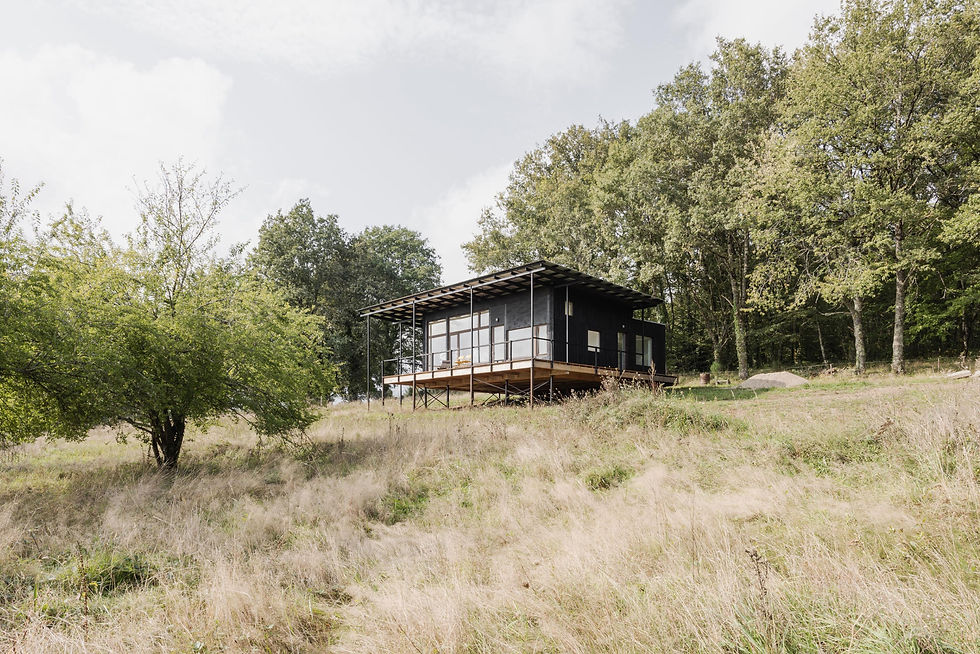
The House in Saint-Julien is an 88-square-meter wooden home in rural Haute-Vienne, France, designed by the Parisian studio Ciguë and completed in 2022. Conceived as a simple, low-impact summer retreat for a Parisian couple, the house stands elevated on removable steel foundations. This approach provides a sharp contrast to the area's traditional stone houses and draws inspiration from the lightweight, post-and-beam Case Study Houses of 1960s California. The house is designed to have minimal impact on its landscape, offering the flexibility to be fully disassembled and relocated without leaving a trace. The design is both modern and reverent of its natural setting. The house is bioclimatic, designed to use natural principles to manage its internal climate. The almost-square, timber-clad volume is elevated on slender, removable steel foundations. This design creates a large, raised wooden deck that wraps around the south side of the home, providing several seating areas with dramatic views over the valley. The elevated design ensures the house sits lightly on the land. Architect Alphonse Sarthout noted that the owners could theoretically take the house with them in 50 years if they chose to. The house is designed to be naturally ventilated. Openings are strategically placed on the east and west to capture cross breezes, aiding in cooling the interior during warmer months. A large, cantilevered roof overhang provides generous shading to the south-facing glazing, further controlling solar gain. The interior is arranged in an L-shape, creating an open-plan living, dining, and kitchen area with full-height glazing that connects the inside with the landscape. The material palette is simple, sustainable, and designed to create a calm, naturalistic atmosphere. The house is clad in blackened Douglas fir, a sustainable local material chosen to contrast with the traditional stone homes of the region. The house rests on removable screw piles, a ground-friendly foundation system that allows the structure to be uninstalled without significant earthwork. Interior walls are made from Fermacell, a fiber gypsum board made from recycled materials. The floor is made from calcium sulfate, a recyclable and insulating material widely used in Europe. Kitchen and storage units feature simple spruce plywood with integrated cut-out drawer pulls instead of hardware, enhancing the minimalist aesthetic. The house is insulated with blown-in cellulose, a thermally efficient and eco-friendly material. Project credits Architecture: Ciguë Lead Architect: Alphonse Sarthout Photography: Maris Mezulis


Architects:


Architect Cyril Chênebeau created the "Two Cabins On Stilts" (Les Cabanes Perchées) in Saint-Martin-Vésubie, France, near the Mercantour National Park, as immersive, all-season getaways. Completed in 2022, the project consists of two identical, nine-sided cabin volumes elevated on V-shaped larch stilts. The design balances a traditional gabled cabin form with a contemporary, "perched" habitat that minimizes its footprint on the forested site. Each cabin is shaped as a nine-sided prism with a double-sided gabled roof. The interior is spacious, with generous ceiling heights that follow the roofline. Large windows and strategically placed openings frame views of the surrounding larch forest, filtering light into the interior throughout the day. The living area is organized around a central hearth, with a visible and connected spa area that is also accessible from the large south-facing terrace. This provides a unique alpine experience for guests. The cabins are clad in dark, charred wood cladding, which echoes the color of the larch tree bark and helps the structures blend into their environment. The cabins are supported by a unique, three-dimensional wooden post structure made of stripped larch poles. The V-shaped posts evoke leaning tree trunks and reinforce the "perched" visual effect. This light-colored structural wood is left exposed to create a visual contrast with the dark facade. The interior features a warm, refined material palette with carefully selected coverings and furniture. Project team and credits Architect: Cyril Chênebeau. Client: SMDVVV (CG06). Photography: Aldo Amoretti. Graphic Design: Marc Miller.


Architects:


Located in Moëlan-sur-Mer, France, Maison I is a bioclimatic individual house designed by architect Emilien Robin and completed in 2009. The project was an early commission for Robin, who at the time was part of the firm Boidot Robin architectes urbanistes and had graduated from the Nantes National School of Architecture in 2006. The house, created as a secondary residence, was designed with a bioclimatic strategy in mind, prioritizing low-energy performance and a minimal construction budget, especially given its location in a coastal area. The design intentionally moves away from purely formal gestures, instead reinterpreting elements of vernacular architecture to create a contemporary house that is deeply connected to its surroundings. The architecture uses a simple, modern design that is well-integrated into the natural landscape. Its understated aesthetic and thoughtful use of materials create a dwelling that is both beautiful and respectful of its environment. Credits Architect: Emilien Robin Architectural Firm: Boidot Robin architectes urbanistes Photography: Clément Guillaume


Architects:


The Soorts Cabin, designed by formalocal, is an extension to an existing house in Soorts-Hossegor, France, completed in 2023. Situated in a garden with pine and cork oak trees, the 43-square-meter cabin was conceived as a detached bedroom raised on stilts. This elevated position and the construction method were chosen to minimize the environmental impact on the existing vegetation and soil. The structure was built using glued laminated timber frames and screw piles, allowing for a lightweight and non-invasive foundation. This approach facilitated construction with minimal disturbance to the natural surroundings. The cabin is part of a larger project, which also included a renovation of the main Soorts House, reflecting a sensitive, site-specific approach to architecture. The design creates a harmonious relationship between the new structure and the natural landscape, offering a secluded and elevated living space among the trees. Credits Architects: formalocal Photography: Sandrine Iratçabal Concrete Structure: irribaren Thermal: b. martin Wood Structure: études alde City: Soorts-Hossegor Country: France


Architects:


Le Refuge KE01 is a black timber cabin nestled in the dunes of Keremma in Brittany, France, designed by Gayet Roger Architects as a family vacation retreat. Built in 2019, the 850-square-foot cabin (79 square meters) is positioned on a raised platform supported by four-foot-tall metal stilts, which protects it from the area's risk of flooding and preserves the natural terrain. A wooden footbridge connects the entrance of the house to a small path that leads to the nearby beach. The cabin's design draws inspiration from traditional Scandinavian architecture, featuring a dark exterior that allows it to blend into the surrounding landscape of tall cypress trees. The cross-laminated timber (CLT) structure is insulated with blown-in cellulose wadding and clad with rough-sawn wood strips painted with black Falun-style paint, a durable Swedish pigment. At night, the house disappears into the darkness, with only the illuminated windows visible like hanging lanterns. Inside, the warm, spruce-clad living spaces are designed with function in mind, stripped of the superfluous. The architects used rough-sawn wood panels for the built-in benches, dining table, shelving, and counters. The open-plan space is punctuated by strategically placed windows that frame specific views of the landscape. The large fixed window in the corner seating nook offers pastoral scenery, while a western bay window can be opened to extend the main room onto the terrace, blurring the line between inside and outside. Upstairs, the four sleeping areas are designed like small cabins. Each features small, eye-level windows that provide views of the landscape for those lying down and can accommodate two single beds, with a built-in bench on one side and a storage area on the other. Credits Architects: Gayet Roger Architects (Aldric Gayet & Anne Gayet) Location: Tréflez, Finistère, France Completion Year: 2019 Photography: Pascal Leopold Foundation: Techno Pieux Nantes Nord Wood Structure, Insulation, Exterior Joinery, Partitioning & Joinery: SARL Construibois Plumbing, Sanitary, Ventilation, Electricity & Wood Stove: SARL Kerbaul Roofing: SARL BCI

Architects:


Designed by locallll and SUPHASIDH, the 100% Wooden House is a 55-square-meter prototype dwelling located in the park of Château de la Bourdaisière in Montlouis-sur-Loire, France. Completed in 2020 after winning a competition in 2019, the experimental project explores the potential of using wood exclusively for residential construction and challenges traditional housing models. Inspired by the historic Château while designed for contemporary life, the house is a single, monolithic volume wrapped in thick, weather-resistant wood that contrasts with the smooth, lighter finish of its interior. A fluid internal space is arranged around a central core, with an "interior topography" of varied heights creating distinct functional zones and offering a variety of possible spatial configurations. The interior features a ramp that doubles as a sofa, and different levels for sitting, cooking, and sleeping help to maximize the compact footprint. A covered terrace is located under the higher-level sleeping area. The project showcases a blend of traditional craftsmanship and modern technology. Untreated chestnut trees that had been previously felled on the castle grounds were processed at a local sawmill using CNC machines. This allowed for a short supply chain and the use of locally sourced materials. The entire structure is elevated off the ground on water-resistant acacia wood piles, allowing it to mimic the surrounding forest environment. All structural elements were prefabricated off-site for rapid assembly, with the cladding cut on-site. The exterior will develop a natural silvery-gray patina over time. The 100% Wooden House is part of an educational promenade in the Château park, feeding on ongoing research and experimentation with wood as a building material. Credits Architects: locallll (Matthieu Boustany, Benoist Desfonds) and SUPHASIDH (Peeraya Suphasidh) Local Executive Architect: Isabelle Poulain Architecte Contractors: Boussiquet Material Suppliers: Piveteau (CLT), Pavatex (insulation), l'André (sawmill) Photographer: Vincent Hecht
Architects:


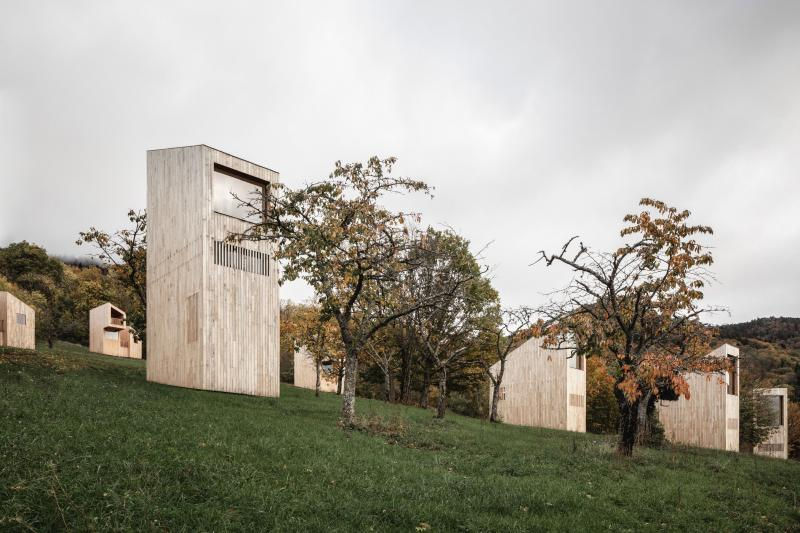
"Tom's Hut, designed by Raumhochrosen Architektur Erzeugnisse, is a minimalist woodland cabin located in the Wienerwald, Austria, and created for an Austrian singer-songwriter and mental coach as a retreat from his hectic city life. The project is a reinterpretation of a dilapidated old building, carefully drafted to align with the passions of its owner. The structure is designed as a sanctuary for recreation, meditation, and personal development, offering a place for its owner to find balance and reconnect with nature. The design of Tom's Hut focuses on simplicity and a deep connection to its environment. The cabin features an angular shape that encloses a two-level space and is constructed entirely of wood, with an untreated larch exterior that helps the small structure blend seamlessly into its forest setting. One of its unique features is the ability to be firmly closed on all sides with wooden shutters, or to have its windows opened to provide varying views of the surrounding wilderness. The interior space, which some have described as ""chapel-like,"" is reduced to the bare minimum, providing only the essentials for a contemplative life. The off-grid nature of the cabin is a core aspect of its design. It deliberately eschews modern amenities like electricity, relying on a single water fountain, an indoor fireplace, an outdoor fire pit, and a stove for cooking and heating. This intentional rusticity provides an escape from modern conveniences and reinforces the project's purpose as a back-to-basics retreat. The thoughtful connection between the interior and the outdoors is emphasized by large openings at the front and back of the hut, visually and physically linking the living space to the surrounding nature. Credits: Client: Thomas Andreas Beck Design Team: Heike Schlauch, Robert Fabach Wood Construction: Meiberger Holzbau Photography: Albrecht Imanuel Schnabel"


Architects:


"""La Petite Maison"" (meaning ""The Little House"") is a 35-square-meter wooden holiday home in the French countryside town of Guitinières, completed in 2020 by the Kyoto-based architecture and maker studio 2m26. Designed and built by the studio's founders, Mélanie Heresbach and Sébastien Renauld, the guesthouse accommodates up to two people and is situated on a sprawling property away from the main residence, surrounded by fields, woods, and an orchard. The project prioritizes a connection to the outdoors, with large windows, glass walls, and an open-air courtyard that blurs the line between the interior and the surrounding landscape. To minimize environmental impact, the minimalist house was constructed using locally sourced Douglas fir boards, a material that can be easily disassembled and recycled. It was assembled on-site with the help of the owners and sits on concrete pillars, which raises it slightly off the ground. The compact structure was designed to provide flexibility, with sliding glass doors and large shutters offering customizable protection from the wind or sun while allowing various views and natural light. The interior features a simple, open layout with four rooms partitioned by an additional set of movable doors and screens. The minimalist design is emphasized by furniture and countertops made from the same Douglas fir, which draws attention to the serene countryside views. Credits Architects: Mélanie Heresbach and Sébastien Renauld of Studio 2m26 Photographer: Studio 2m26"


Architects:


"Completed in 2019, Maison Silex (Flint Shelter) is a tiny, 45-square-meter cabin designed by Maud Thoumyre of TAM Architecte. Situated in the village of Veules-les-Roses along France's Alabaster Coast, the cabin draws inspiration from the area's history and landscape, which is defined by flint, brick, and sandstone. The cabin's design is a protective response to the coastal climate, acting as a shelter from the harsh wind, rain, and sea spray. The house is intentionally reminiscent of the area's historic flint-and-brick homes. The small structure is built into a grassy cliffside slope overlooking the sea. Its design emphasizes the dichotomy between being open to the sun and sea during the day and closed off for intimacy and security in the evening. The exterior features load-bearing flint walls, referencing the material common in the region, while the interior is finished with slate flooring. A wood-burning fireplace provides warmth and a cozy atmosphere against the coastal storms. The cabin's windows provide views of the sea, which, along with the sky, are a constant part of the cabin's experience. Credits Architect: Maud Thoumyre Architecte (TAM Architecte) Architectural Team: Maud Thoumyre and Nicolas Lemoine Photography: Nathan R. Lainé Manufacturers: Autodesk, Adobe, CMEG, T2C, Technibaie Location: Veules-les-Roses, France"


Architects:

The O_CASELLA cabin is a prefabricated wooden shelter designed by Atelier LAVIT, the Paris-based architecture and design practice founded by Marco Lavit. Located in a spectacular landscape on the eastern plain of Corsica, France, the cabin was conceived to allow for full immersion in nature while maintaining comfort and protection. The name O_CASELLA is a play on the word "casella," which means "little box" or "shelter" in Corsican, reflecting the cabin's functional and minimalist nature. The design of O_CASELLA is based on two distinct, yet connected, modular volumes: a living module and a pergola. This structure addresses the demands of the warm Mediterranean climate by creating large, shaded areas for outdoor living. To minimize cost and environmental impact on the remote site, the entire cabin was prefabricated in a wood workshop. The modules were then transported fully assembled to the location, significantly reducing on-site construction time and disruption. The closed living module contains the kitchen, bathroom, and a flexible living/sleeping area. It provides framed views of the surrounding wild Corsican mountains and sea through large windows. The open-air pergola provides a ventilated and shaded space for outdoor relaxation, reading, or contemplating the landscape. A movable, mashrabiya-style shutter on a rail system allows occupants to regulate sunlight and air flow. The exterior structure and cladding are made from local Corsican larch (laricciu), a lightweight yet strong wood that contributes to the cabin's portability and durability. The interior walls and ceiling are lined with MDF wood, creating a cozy and protective atmosphere. A generous covered pergola extends the living space outdoors, with an outdoor shower providing an even more direct connection to nature. A steel beam on the façade serves a dual purpose: it hides the rail system for the sliding shutter panel and acts as a gutter for collecting rainwater. The movable mashrabiya panel offers passive cooling and sun protection. The modular system allows for flexibility in installation and configuration, showcasing a forward-thinking approach to sustainable architecture. Project credits Architect: Atelier LAVIT Principal Architect: Marco Lavit Location: Sari-Solenzara, Corsica, France Completion Year: 2022 Photography: Atelier LAVIT
Architects:


