


Facts:

Description:
the Architects
Text description by
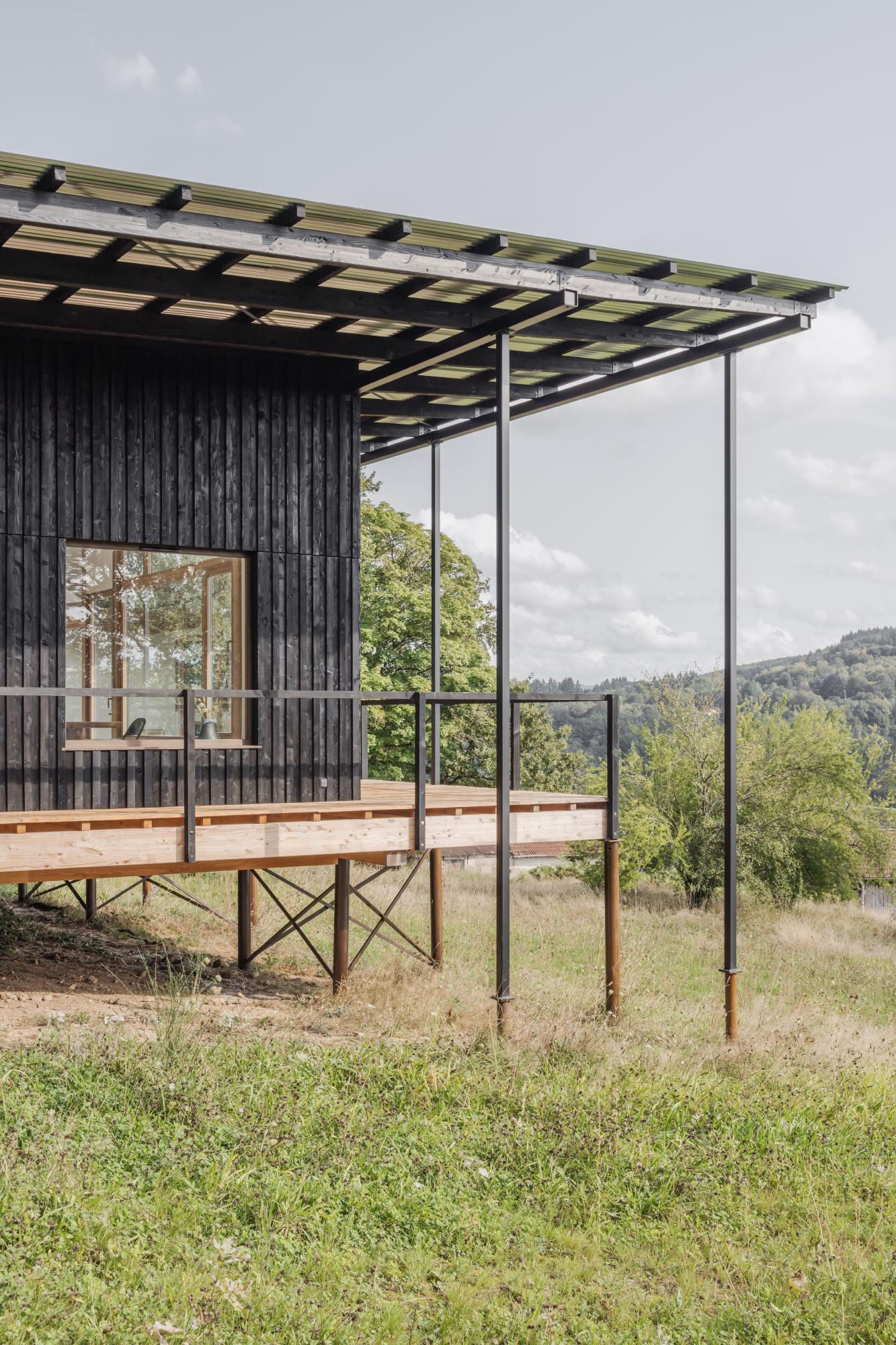
The House in Saint-Julien is an 88-square-meter wooden home in rural Haute-Vienne, France, designed by the Parisian studio Ciguë and completed in 2022. Conceived as a simple, low-impact summer retreat for a Parisian couple, the house stands elevated on removable steel foundations. This approach provides a sharp contrast to the area's traditional stone houses and draws inspiration from the lightweight, post-and-beam Case Study Houses of 1960s California. The house is designed to have minimal impact on its landscape, offering the flexibility to be fully disassembled and relocated without leaving a trace.
The design is both modern and reverent of its natural setting. The house is bioclimatic, designed to use natural principles to manage its internal climate. The almost-square, timber-clad volume is elevated on slender, removable steel foundations. This design creates a large, raised wooden deck that wraps around the south side of the home, providing several seating areas with dramatic views over the valley.
The elevated design ensures the house sits lightly on the land. Architect Alphonse Sarthout noted that the owners could theoretically take the house with them in 50 years if they chose to.
The house is designed to be naturally ventilated. Openings are strategically placed on the east and west to capture cross breezes, aiding in cooling the interior during warmer months. A large, cantilevered roof overhang provides generous shading to the south-facing glazing, further controlling solar gain.
The interior is arranged in an L-shape, creating an open-plan living, dining, and kitchen area with full-height glazing that connects the inside with the landscape.
The material palette is simple, sustainable, and designed to create a calm, naturalistic atmosphere.
The house is clad in blackened Douglas fir, a sustainable local material chosen to contrast with the traditional stone homes of the region. The house rests on removable screw piles, a ground-friendly foundation system that allows the structure to be uninstalled without significant earthwork.
Interior walls are made from Fermacell, a fiber gypsum board made from recycled materials. The floor is made from calcium sulfate, a recyclable and insulating material widely used in Europe. Kitchen and storage units feature simple spruce plywood with integrated cut-out drawer pulls instead of hardware, enhancing the minimalist aesthetic.
The house is insulated with blown-in cellulose, a thermally efficient and eco-friendly material.
Project credits
Architecture: Ciguë
Lead Architect: Alphonse Sarthout
Photography: Maris Mezulis
Team

In This Project:

Presentation / Gallery:
.




Plans & 2Ds:
Materials Used:
More Projects by
Ciguë
About
Ciguë:
Ciguë is a French architecture and design firm founded by Camille Bénard, Hugo Haas, Guillem Renard, and Alphonse Sarthout in Montreuil, near Paris. Initially established as a carpentry and joinery workshop while the founders were studying architecture, the practice bridges craft, science, and poetry. Ciguë is known for its transdisciplinary approach, blending intellectualism with craftsmanship and intuition. The firm emphasizes working with materials and has developed expertise in sustainable techniques, including using recycled materials and exploring alternatives to concrete. They work on a diverse range of projects including residential, commercial, and cultural buildings, and have collaborated with luxury brands like Aesop and Isabel Marant to introduce more ecological approaches.
