

Please Wait


The Atelier, designed by Czech architect Jan Tyrpekl, is a 68-square-meter three-season workspace and wellness retreat located in the woods near Stříbrná Skalice, a rural village east of Prague. Completed in 2022, the project is a sustainable and resourceful endeavor, built almost entirely from locally sourced, recycled, and donated materials from previous constructions. The building process was a collaborative effort involving friends and family, reflecting a "labor of love" approach. The structure is divided into three distinct parts, creating a harmonious balance between work and relaxation: a small studio with basic sanitary facilities, a sauna with an adjacent beekeeping workshop, and an open terrace that connects the two volumes. The design is based on a simple, gabled-roof massing, with strategically placed north-facing windows to prevent overheating during the summer while maximizing natural light. Storage niches for firewood are integrated into the facades, which aids in insulation during colder months. The building is heated by wood-burning stoves in both the studio and the sauna. The Atelier's foundation consists of concrete footings that support an admitted timber frame, which carries individual insulated timber panels. Its design is intended to engage with the surrounding landscape, offering expansive views of the valley and nearby forest, and providing a flexible space for various activities, including work, relaxation, family gatherings, or accommodating guests. Credits Architects: JAN TYRPEKL Lead Architect: Jan Tyrpekl Photography: Antonín Matějovský Construction: Largely self-built with the help of friends and family Location: Stříbrná Skalice, Czech Republic


0
Product
4.6K
Views
0
0
Please Log in
The Atelier
Stříbrná Skalice, Czechia

the Architects
Description:

+14


...
Comments
0
JAN TYRPEKL
More Projects by


The Zen House is a tiny, 33-square-meter elevated cabin designed by architect Jan Tyrpekl for a farm complex in Hainburg an der Donau, Austria. Completed in 2023, the cabin was commissioned to provide a unique and serene retreat for relaxation, offering a deep connection with the surrounding nature, which includes an orchard and mature trees. The dwelling is perched on 4-meter-high concrete stilts, allowing the landscape to flow unimpeded beneath and creating a feeling of being in a "bird's nest," which offers a sense of security and intimacy. The structure is built from sustainable materials, featuring a frame of glued laminated spruce timbers and a platform and roof of cross-laminated timber (CLT) panels. The lower part of the structure and the terrace are made from glued laminated larch timbers. The most prominent feature of the design is the extensive use of glass walls, which enclose the entire living space to provide uninterrupted, 360-degree views of the natural surroundings. For privacy, interior curtains can be drawn. The open-plan interior is designed for simplicity and comfort. It includes a built-in bed, a connected bar/kitchenette, and a suspended fireplace that creates a cozy, warm atmosphere. The space is divided into distinct zones for sleeping, sitting, and conversing. Large HS portals—sliding doors—provide access to a spacious terrace overlooking the farm's orchard. While the current cabin lacks a bathroom and cooking facilities, plans are in place for a future expansion that will add a sauna, shower, and toilet in the space between the supporting pillars beneath the house. Credits Architects: JAN TYRPEKL Lead Architect: Jan Tyrpekl Photographer: Jakub Hrab Manufacturers: 2MAD Building s.r.o., DÍLO.work, Okna Jánošík Structure Engineer: 2MAD s.r.o. Project Manager: 2MAD s.r.o. Location: Hainburg an der Donau, Austria


Hainburg an der Donau, Austria


The Shelter, also referred to as "The Cabin" or "Útulna," was an experimental wooden structure designed by architect Jan Tyrpekl and built in 2017. The 12.5-square-meter cabin is situated on top of a disused World War II concrete bunker near the border of the Czech Republic and Austria. This was part of an architectural statement to repurpose the thousands of bunkers left in the landscape after they were never used for their intended purpose. By designing a light, removable wooden structure, Tyrpekl aimed to minimize the impact on the existing historical structure. The project was executed with minimal material, cost, and time. It was built with the help of friends, family, and architecture students, rather than being funded by donations or grants. Because of logistical challenges, the cabin was first assembled at a family farm 200 kilometers away, then disassembled and reassembled on the bunker. The design demonstrates that a generous interior space can be created within a very small footprint. The building features two large windows—one facing the Austrian border and the other facing a nearby village church—and an additional rooftop window, ensuring the small space is filled with natural light and scenic views. The simple wooden design was constructed using only common tools. The Shelter serves as a small retreat, and anyone can arrange to stay there with the owner's permission. In 2018, the project received a Czech Architecture Award nomination, with the jury praising its ability to make the invisible visible, its philosophical approach to marking a special place, and its simple, natural materials that achieve maximum impact with minimal means. Credits Architect: Jan Tyrpekl Team: Jaroslav Kejř, Adam Ulrich, and Jan Hyk Collaborators: Friends, family, and architecture students Photographer: Antonín Matějovský


Czechia
Please Wait
The Atelier
0
0
3D models
Product
4.6K
Views
0
Please login to appreciate
...
...
...
Source:
Published on
...
by:

Member
Details
Facts:

Team

Details
Details
Full Name
In This Project:

Presentation / Gallery:
.
Plans & 2Ds:
Materials Used:
More Projects by
Full Name
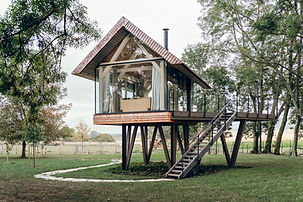
The Zen House is a tiny, 33-square-meter elevated cabin designed by architect Jan Tyrpekl for a farm complex in Hainburg an der Donau, Austria. Completed in 2023, the cabin was commissioned to provide a unique and serene retreat for relaxation, offering a deep connection with the surrounding nature, which includes an orchard and mature trees. The dwelling is perched on 4-meter-high concrete stilts, allowing the landscape to flow unimpeded beneath and creating a feeling of being in a "bird's nest," which offers a sense of security and intimacy. The structure is built from sustainable materials, featuring a frame of glued laminated spruce timbers and a platform and roof of cross-laminated timber (CLT) panels. The lower part of the structure and the terrace are made from glued laminated larch timbers. The most prominent feature of the design is the extensive use of glass walls, which enclose the entire living space to provide uninterrupted, 360-degree views of the natural surroundings. For privacy, interior curtains can be drawn. The open-plan interior is designed for simplicity and comfort. It includes a built-in bed, a connected bar/kitchenette, and a suspended fireplace that creates a cozy, warm atmosphere. The space is divided into distinct zones for sleeping, sitting, and conversing. Large HS portals—sliding doors—provide access to a spacious terrace overlooking the farm's orchard. While the current cabin lacks a bathroom and cooking facilities, plans are in place for a future expansion that will add a sauna, shower, and toilet in the space between the supporting pillars beneath the house. Credits Architects: JAN TYRPEKL Lead Architect: Jan Tyrpekl Photographer: Jakub Hrab Manufacturers: 2MAD Building s.r.o., DÍLO.work, Okna Jánošík Structure Engineer: 2MAD s.r.o. Project Manager: 2MAD s.r.o. Location: Hainburg an der Donau, Austria
Zen House
RESIDENTIAL
Cabin
Hainburg an der Donau, Austria

The Shelter, also referred to as "The Cabin" or "Útulna," was an experimental wooden structure designed by architect Jan Tyrpekl and built in 2017. The 12.5-square-meter cabin is situated on top of a disused World War II concrete bunker near the border of the Czech Republic and Austria. This was part of an architectural statement to repurpose the thousands of bunkers left in the landscape after they were never used for their intended purpose. By designing a light, removable wooden structure, Tyrpekl aimed to minimize the impact on the existing historical structure. The project was executed with minimal material, cost, and time. It was built with the help of friends, family, and architecture students, rather than being funded by donations or grants. Because of logistical challenges, the cabin was first assembled at a family farm 200 kilometers away, then disassembled and reassembled on the bunker. The design demonstrates that a generous interior space can be created within a very small footprint. The building features two large windows—one facing the Austrian border and the other facing a nearby village church—and an additional rooftop window, ensuring the small space is filled with natural light and scenic views. The simple wooden design was constructed using only common tools. The Shelter serves as a small retreat, and anyone can arrange to stay there with the owner's permission. In 2018, the project received a Czech Architecture Award nomination, with the jury praising its ability to make the invisible visible, its philosophical approach to marking a special place, and its simple, natural materials that achieve maximum impact with minimal means. Credits Architect: Jan Tyrpekl Team: Jaroslav Kejř, Adam Ulrich, and Jan Hyk Collaborators: Friends, family, and architecture students Photographer: Antonín Matějovský
The Cabin
EXPERIMENTAL
Cabin
Czechia
About
..
Jan Tyrpekl is a Czech architect known for his sustainable and context-sensitive projects, often using natural and local materials to integrate with the environment. His work, which includes self-built and collaborative designs, often focuses on minimalist and functional forms, such as the Zen House in Austria and the Atelier in the Czech Republic. His practice emphasizes a deep connection with the landscape, with a portfolio of award-winning projects that are frequently featured in international design publications. While based in Prague, Tyrpekl works on projects across the region, including in neighboring Austria.
Category
...
Post Type
...
Project Type
...
Country
...
Year
...
Area
...
Client
...
Photographers
...
...