

United Kingdom
The rank indicates the popularity of a country among users. By clicking on the 'Appreciate' button, you can contribute to elevating a country's rank. Each 'Appreciate' click adds to the country's rank, so feel free to express your appreciation by boosting countries with content that resonates with you.
50
Rank
...
Views
0
Please login to appreciate


Architects:
Area:
69,965 sq.ft
Year:
2001
City:
Manchester
Client:
Imperial War Museum North


No Buildings yet.









.png)




The Black Timber House, designed by HAPA Architects, is a contemporary eco-home located on the edge of the village of Rodmell, within the South Downs National Park in East Sussex, England. Completed in 2022, the award-winning residence is situated in a bucolic context, replacing a mid-century bungalow that had a less harmonious relationship with the landscape. The design is a sensitive and modern response to its setting, nestled among ash trees and fields, with its dark timber exterior allowing it to recede softly into the scenery. The house was conceived with a strong focus on sustainability, with the goal of creating a home that respects its surroundings and has minimal energy consumption. HAPA Architects employed a range of passive and active strategies to achieve this. Key features include an A-rated Energy Performance Certificate (EPC), high levels of insulation and air tightness, and a passive solar design. The house also generates its own power via photovoltaic (PV) panels on the roof and uses a high-efficiency air source heat pump for low-temperature underfloor heating. A mechanical ventilation with heat recovery (MVHR) system ensures a constant supply of fresh air, contributing to a stable and calm internal atmosphere regardless of external weather conditions. The architectural design features two distinct stacked forms, which create interesting overhangs and roof spaces. The lower level is built on a concrete plinth, while the upper, private bedroom spaces are housed within a simple gabled form that reaches up into the canopies of the trees. The transition from horizontal timber cladding on the lower level to vertical timber on the upper level accentuates this distinction. A covered entrance and a raised, open veranda connect the house to the rear garden and fields. Inside, the vaulted ceilings of the bedrooms create impressive double-height spaces, and a wrap-over window adds dramatic natural light. The interior continues the minimalist and elegant aesthetic with natural materials. The kitchen features bespoke cabinetry crafted from cross-sawn, smoked, and white-oiled engineered oak planks, a material that also serves as the timber flooring. This provides a rustic yet refined texture that complements the home's contemporary feel. A natural patinaed zinc worktop works beautifully with the other natural finishes. Credits Architecture and Design: HAPA Architects (Stuart Paine, Director) Photography: Jim Stevenson Timber Flooring and Bespoke Cabinetry: Chaunceys Timber Flooring Location: Rodmell, Lewes, East Sussex, UK Clients: Louise and her partner


Architects:


Architects:


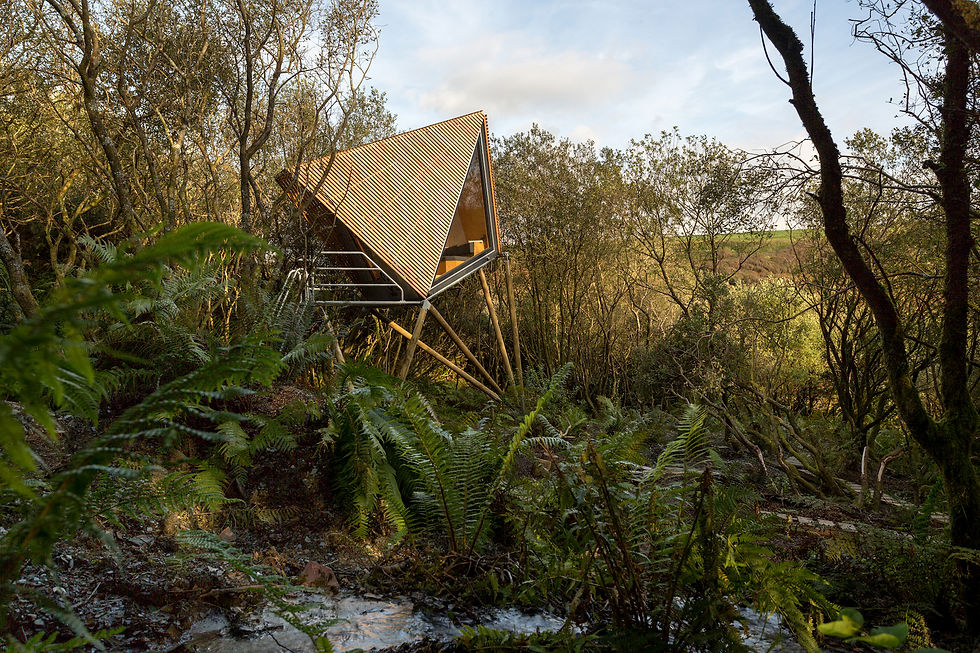
"Tucked into an ancient woodland in the High Weald Area of Outstanding Natural Beauty in southern England, the Looking Glass Lodge by Michael Kendrick Architects is an eco-friendly cabin designed for immersion in nature with minimal environmental disruption. The lodge was commissioned by a client whose parents had spent decades cultivating the woodland, and the project's goal was to share the landscape with guests while preserving the area's sensitive ecology. The modest, 49-square-meter structure is deliberately unobtrusive, appearing to float among the trees on its sloped site. A key feature of the design is the use of floor-to-ceiling electrochromic glass facades on the front and rear of the lodge. This intelligent glazing automatically adjusts its transparency to provide privacy and control solar heat gain, while also preventing light pollution at night, which helps protect the local bat population. The large, seamless windows maximize views of the woodland and create a ""looking glass"" effect, making the interior feel intimately connected to its surroundings. The lodge was constructed by local craftsmen from nearby Hastings, with much of the fabrication done off-site to minimize on-site disruption. Its low-impact design includes a hybrid steel and timber-framed structure supported by steel screw piles. This foundation system avoids damaging the tree roots, ensures no trees were felled, and allows for unobstructed movement of wildlife across the site. The exterior is clad in untreated Western red cedar, which will weather to a silvery-grey color over time, blending naturally with the environment. Inside, the Scandinavian-inspired interior features a warm material palette of Western red cedar lining and birch plywood cabinetry. An open-plan layout contains a living area with a wood-burning stove fueled by timber from fallen local trees, a custom kitchen, and a private bedroom. The bathroom includes a freestanding bathtub with expansive views of the forest, further cementing the lodge's biophilic design principles. Project credits Architecture: Michael Kendrick Architects Structural Engineer: Momentum (Project Engineer: Pamela Ewang) Landscaper: Rutty Sark Gardens Ecological Consultant: The Ecology Consultancy Interior Designer: Looking Glass Lodge Photography: Tom Bird "


Architects:


"Situated on a working farm in the heart of Devon, England, the Holly Water Cabin is a sustainable holiday retreat designed and built by the Devon-based studio Out of the Valley. Completed in 2021, the cabin was conceived as a self-contained getaway to invite its inhabitants into a close relationship with the outdoors while providing a high level of comfort and craftsmanship. Revenue generated from renting the cabin also supports the rewilding of the surrounding farmland to bring back biodiversity and wildlife. The exterior features a rugged, natural aesthetic with a mono-pitched roof made from corrugated metal that protects the structure with generous eaves. It is clad in cedar from a Dartmoor mill and constructed with an exposed Douglas fir frame. To minimize its environmental impact, the cabin is raised off the ground on pier foundations, reducing the need for concrete. Inside, the cabin features an open-plan layout defined by natural materials and meticulous craftsmanship. The interior walls are covered in a breathable clay render, which helps regulate temperature and humidity while providing a pleasing, organic texture. An oak kitchen lines one wall, and a cozy sleeping area is tucked into the gable end. Large, sliding glass doors link the interior with a sweeping larch veranda, expanding the living space to the outdoors. A copper bathtub on the deck offers a luxurious way to connect with the landscape. Project credits Design and Build: Out of the Valley Designer: Rupert McKelvie Photography: Rupert McKelvie, Stephanie Osmond Clay plaster supplier: Clayworks Roofing supplier: Cladco Corrugated Sheets Client: Holly Water Cabin"


Architects:


"The Lake Cabin is a modern retreat located on the edge of a lake in Brabourne, within the Kent Downs Area of Outstanding Natural Beauty in South East England. Designed by RX Architects, the cabin is approached on foot via a woodland trail, as it is not accessible by vehicles. The project reflects a ""sense of place,"" using natural materials to create a strong visual connection between the structure and its rural environment. The 35-square-meter cabin is designed with an exposed timber frame and features two full glazed elevations that angle out toward the water. These sliding glass walls open up to a cantilevered deck that hovers over the water, providing seamless access for activities like swimming and kayaking. The building is clad in a mix of rough-sawn and planed English oak planks, which are left unfinished to weather naturally over time and integrate further with the landscape. A concrete base acts as a datum line, stepping up to form a bench and log store. The roof and its trims are clad in a contrasting patinated bronze finish. Inside, the cabin features a restrained, open-plan layout with a garden room, kitchen, and a wet room on the main level. Wide-format Douglas Fir boards line the interior walls, adding to the cabin's natural, rustic feel. A mezzanine level provides a sleeping area. The entire design is oriented toward maximizing views of the lake and surrounding countryside. Credits Architects: RX Architects Lead Architects: Rob Pollard Photography: Ashley Gendek Consultants: Chartwood Joinery Contractor: Coastview Property Ltd Engineering: Price & Myers Landscape: Marian Boswall Landscape Architects"


Architects:


"Completed in 2024, the Garden Room by Wilkinson King Architects is a detached, 24-square-meter private annex located in the garden of a Grade II listed Victorian house in Stockwell, south London. The project was commissioned by the client to provide a home for their mother who had moved to the city to be near family. Built on the site of a former raised terrace, the new structure is designed to harmonize with its garden setting. The design is sensitive to its surroundings, particularly the large tree canopy that provides protection for the small building. The exterior is clad in charred timber (shou sugi ban), which takes on the dark tones of its environment and provides protection from the elements. The form is characterized by a rectilinear elevation contrasted by a large, circular, moon-like opening. A pergola structure acts as an intermediate threshold between the shared garden and the interior. This space can be screened for privacy by sliding lattice panels that mask the full-width glazing. The interior of the single-room space is designed to feel bright and open. Birch plywood wall linings give a soft, warm feel, while Douglas fir flooring provides an organic texture. The roof features exposed diagonal joists, reminiscent of tree branches, and circular skylights cast dappled light onto the floor and provide views of the tree canopy above. A full-height cupboard divides the space to create a separate shower room while maintaining visual continuity of the ceiling. The highly sustainable design features excellent insulation, electric underfloor heating, and natural light and ventilation. The dry-construction technology is fully reversible, as the structure is built on small screw piles that can be easily removed. Credits Architects: Wilkinson King Architects Structural Engineer: Structure Haus M&E: Lamorbey Associates Principal Designer & CDM: Wilkinson King Approved Building Inspector: Integral BCS Main Contractor: 3 Build Construction Photography: David Grandorge"


Architects:


